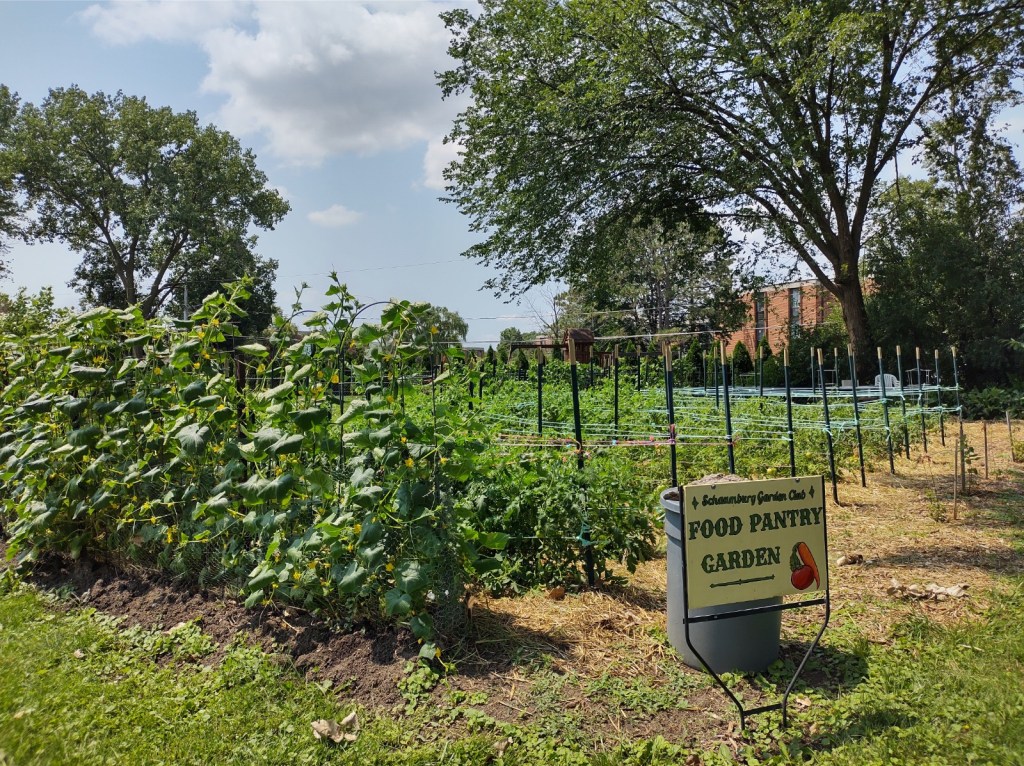
The garden club has maintained a vegetable garden since its inception in 1989. All produce is grown for donation to local food pantries, with a majority going to the Schaumburg Township Food Pantry.
The original garden for many years was a part of community space provided by the Schaumburg Park District at the Olympic Park Athletic Fields. To make way for construction, a new garden was started in 2008 on property generously made available by the Lord of Life Lutheran Church. The church also provides valuable access to water.
The garden is completely volunteer-driven with a team made up of club members as well as family, friends, others in the community who also have an interest in participating. Gardening experience is not required as there are always volunteers ready to teach others about how to help in the garden.
The team’s work begins in late winter/early spring with planning efforts and arrangements for seeds, home growing of transplants and acquisition of other transplants from local nurseries. The planned crops are reflective of input from the local food pantries as we try to supply produce that those in need will find familiar and appealing.
In late spring, cool season vegetables are planted. These often include leafy greens, cabbage, broccoli and radishes. A wide variety of summer vegetables are planted usually by the first week of June. Favorites include tomatoes, peppers, potatoes, onions, zucchini, beans, carrots, cucumbers, leeks and okra. A final planting of cool season vegetables (a repeat planting of spring) comes in August/September. Garlic is planted in October for over-wintering and harvest in the next summer.
Once the growing season is underway, the team usually meets three mornings a week (Tuesdays, Thursdays, Saturdays). Activities usually include plant maintenance, watering, weeding, harvesting, and delivery of produce.
The garden space is a mix of in-ground planting space as well as raised beds for crops that would otherwise not do well in our heavy soil or would be eaten by our hungry rabbits. We devote several raised beds contained as effective metal galvanized tubs to herbs, both perennials and annuals.
A mini orchard is under development with cherry and pawpaw trees and honeyberry bushes gradually maturing to where they will all be producing fruit for sharing with the food pantries.
Successful gardens usually include space for pollinator-attracting flowers. The pantry garden includes many native and non-native plantings that are meant to invite bees, butterflies and other useful insects to the space. Our garden has earned a Monarch Waystation designation.
Two large composting areas exist, with most garden waste being recycled. The compost is regularly used in the garden. We generally prefer the use of organic fertilizers and insect control. We collect autumn leaves from our garden club members to help replenish the soil.


 Schaumburg Community Garden Club